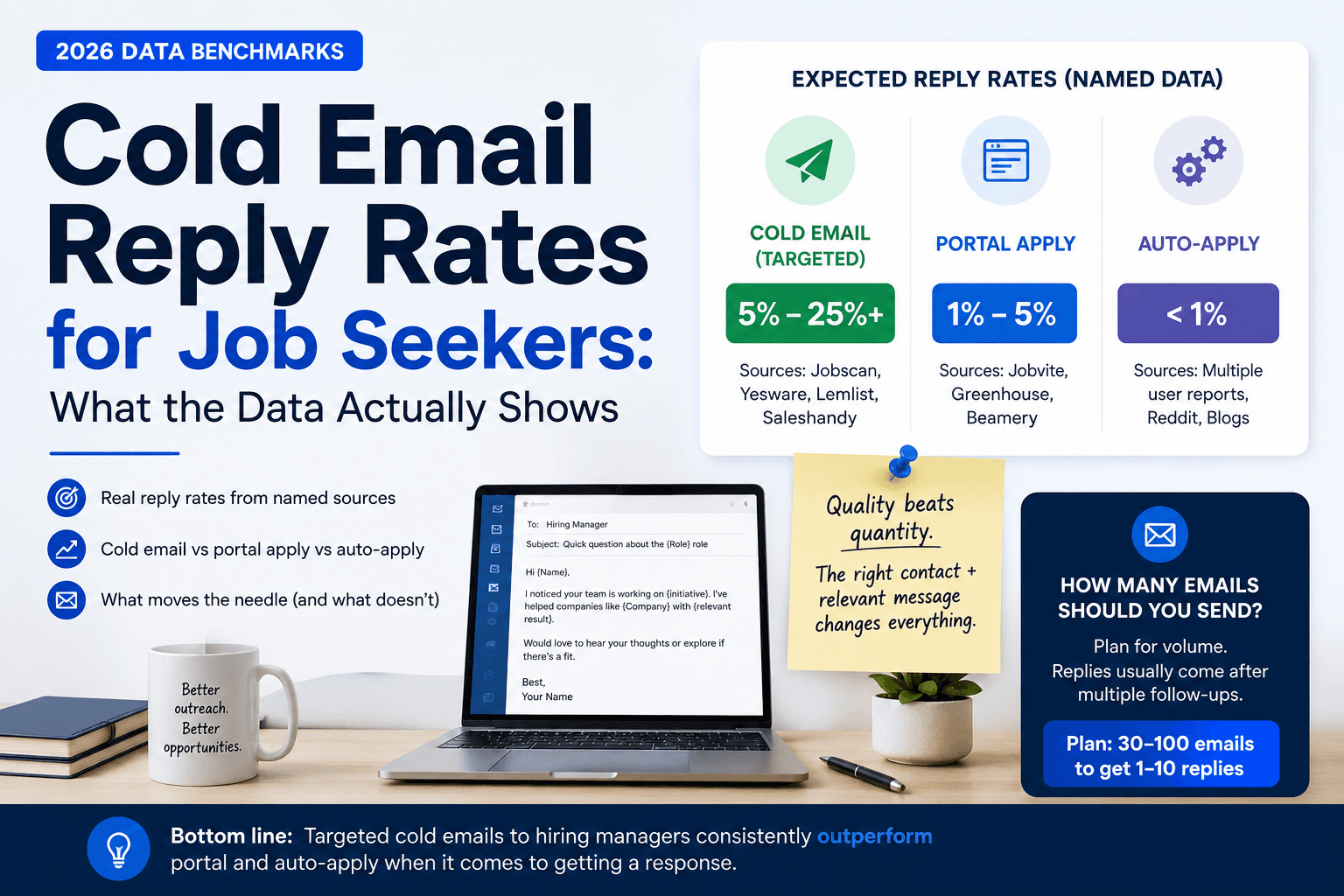
Most job seekers should plan on roughly 5% to 15% total reply rates from well-targeted cold email to hiring managers, not the 3% to 4% B2B sales average. Portal applying and high-volume auto-apply often produce far fewer conversations per hundred attempts. The gap is not magic: verified contacts, short role-specific copy, and one timed follow-up move you from the average band toward the strong band interviewing.io documents for personalized outreach.
Job boards and auto-apply tools optimize for applications sent. Reply-rate data optimizes for conversations started. Those are different funnels. This article collects named, attributable benchmarks for job seekers: what to expect by channel, what personalization actually changes, how many emails to budget, and what deliverability mistakes zero out your odds before a hiring manager reads sentence one. No invented case studies. Every number ties to a published source or a clearly labeled anecdotal band.
What is a realistic cold email reply rate for job seekers?
Plan on 5% to 15% total replies when you email verified hiring managers with role-specific copy. B2B cold-email platform averages cluster around 3.4% to 3.7% (Instantly benchmark data cited by Whali; Saleshandy analysis of 53 million emails, January to June 2026). Job-search outreach to managers who can act on hiring often beats that average because the ask is narrower than a sales pitch.
Separate total reply from positive reply. Interested responses, warm redirects ("talk to my colleague"), and polite "not now" notes all count when you are learning what works. Only a subset become screens or interviews.
interviewing.io's hiring-manager outreach guides describe template bands from roughly 25% to 50% when you find genuine common ground tied to the manager's work, down to 5% to 25% for accomplishment-led notes used as a last resort. TurnAndTurn, cited in outreach research roundups, reports personalized cold email around 40% to 50% response versus 2% to 3% for generic applications. Treat the upper band as what strong targeting and research can approach, not a guarantee on every send.
Whali's aggregated student internship scenario (100 personalized emails, third-party data) landed near 11.5% total reply. Use that as planning math, not as PitchHired customer data.
How do reply rates compare: portal apply, cold email, and auto-apply tools?
Portal applying often yields single-digit or sub-1% meaningful response when hundreds compete in one ATS queue. Auto-apply volume (community-tested batches) frequently reports roughly 0% to 1% per 100 to 300 applications. Targeted cold email to the right manager competes in a much smaller inbox pool; interviewing.io reports one to two orders of magnitude more responses than online applying alone.
| Channel | Typical response band | Source | Notes |
|---|---|---|---|
| Online portal / ATS apply | Roughly 0.1% to 2% offer or response | The Interview Guys (via Whali); interviewing.io narrative | High volume, low human review |
| Mass auto-apply (100 to 300 apps) | Roughly 0% to 1% meaningful; occasional ~5% outliers | Community-tested anecdotes (Reddit) | Volume does not equal conversations |
| B2B cold email (platform average) | Roughly 3.4% to 3.7% | Instantly / Saleshandy 2026 reports | Baseline, not job-search specific |
| Targeted cold email to hiring manager | Roughly 5% to 15% planning range; higher with deep personalization | interviewing.io templates; Whali internship aggregate | Requires verified contact |
| Personalized cold email (best practice) | Up to 40% to 50% cited vs 2% to 3% generic apps | TurnAndTurn (outreach research roundups) | Upper band; strong targeting required |
Channels differ because the bottleneck moves. Portal queues run ATS keyword filters before a human opens anything. A single posting can attract hundreds of applicants. Direct email to a hiring manager often competes against a handful of messages, not a ranked database. For the full bypass playbook, see how to bypass the ATS with direct hiring-manager email.
Auto-apply tools (LoopCV, Sonara, and similar) optimize application count, not reply rate. They can be useful for inventory discovery, but the conversion math above is why direct outreach belongs in the same search strategy, not as an afterthought.
What actually moves reply rates from average to strong?
Contact quality, proof in the first sentences, and length move reply rates more than subject-line tricks alone. interviewing.io's highest band requires common ground tied to the manager's work. Best-practice length stays around 50 to 125 words. One follow-up at five to seven business days captures a large share of eventual replies (Saleshandy reports roughly 44% of positive replies from follow-ups on B2B sequences).
- Targeting: email the hiring manager or team lead, not careers@ or a random recruiter. Start with finding the right stakeholder.
- Copy structure: one company-specific observation, one concrete credential, one low-friction ask. See the technical cold email template guide.
- AI drafts: a writer pass still needs a reviewer pass so the note does not read like template spam. See humanizing AI cold email to hiring managers.
- Follow-up ceiling: initial email plus one brief follow-up is the professional standard. A third message to the same person usually reads as pressure.
- Batch size: Saleshandy found sequences under 200 prospects generated nearly twice the replies of large blasts. Job seekers should think in tens per week, not hundreds.
How many cold emails do you need to land one interview?
Work backward from reply rate, then haircut for interview conversion. At 10% replies, ten targeted emails might yield one conversation; at 5%, plan on twenty. Not every reply becomes a screen. A practical cadence while employed: 15 to 25 researched emails per week, one follow-up pass the next week, then measure before scaling volume.
Whali's 100-email internship aggregate (third-party data) suggests roughly 8 to 12 total replies and 1 to 3 offers over a 6 to 8 week campaign when outreach stays personalized. Contrast with auto-apply math: 300 portal applications at 1% might produce three conversations, with less control over who reads your profile and more noise from irrelevant postings.
Measuring reply rate per batch tells you whether to fix targeting (wrong title or company) or copy (generic opener, too long, weak ask). Volume without measurement is how candidates burn weeks on the wrong lever.
What kills reply rates before anyone reads your message?
Deliverability and sender trust cap reply rates at zero. Shared bulk-proxy sending, HTML blasts, tracking pixels, and velocity spikes land in spam or Promotions. Sending plain-text from your authenticated Gmail inherits SPF/DKIM alignment and personal sender history. Unverified addresses bounce; wrong titles waste sends.
B2B deliverability research (Martal and similar 2026 roundups) notes that a meaningful share of cold email never reaches any inbox because of bounces and spam filtering. Treat that as a deliverability caution: if the message does not arrive, reply rate is undefined.
PitchHired is built for targeted batches, not bulk blasts: dual-AI writer and reviewer loops for role-specific copy, hiring-manager contact discovery via Hunter and Apollo enrichment, company research from scraped site markdown, and plain-text sends from your Gmail via OAuth with business-hours scheduling, randomized delays, and daily caps tied to inbox warming. See Gmail OAuth deliverability for job-search outreach for the full sending-infrastructure breakdown.
Frequently asked questions about cold email reply rates
What is a good cold email reply rate for a job search?
For targeted outreach to hiring managers, 5% to 15% total replies is a realistic planning range when contacts are verified and copy is role-specific. Deep personalization with clear common ground can reach higher bands in interviewing.io's published templates, but mass or generic sends usually land near B2B averages of roughly 3% to 5%.
Is cold email better than applying online?
Named research from interviewing.io reports one to two orders of magnitude more responses from cold outreach to hiring managers than from online applying alone. Portal queues bury most CVs in ATS filters before a human reads them. Direct email does not guarantee an interview, but it competes against far fewer messages in a decision-maker inbox.
How many cold emails should I send to get one interview?
Plan backward from your target reply rate. At 10% replies, roughly ten well-researched emails might yield one conversation; at 5%, plan on twenty. Not every reply becomes an interview. One follow-up about five to seven business days after the first touch often captures replies from busy managers who saw but did not answer the first note.
Do auto-apply tools have good reply rates?
Auto-apply volume rarely converts to conversation at the same rate as direct outreach. Community-tested batches often report roughly 0% to 1% meaningful response per 100 to 300 portal applications, with occasional outliers. High application count is not a substitute for verified hiring-manager contact and personalized copy.
Does sending from my own Gmail affect reply rates?
Yes. Messages sent through your authenticated Gmail inherit Google's SPF and DKIM alignment and your sender reputation. Shared bulk-proxy sending from auto-apply tools can hurt deliverability. PitchHired sends plain-text mail via OAuth from your inbox with paced scheduling and daily caps so targeted batches stay inside safe Gmail velocity.
Ready to land interviews faster?
Stop uploading resumes to automated portals. Start pitching directly to hiring decision-makers today.
Get started