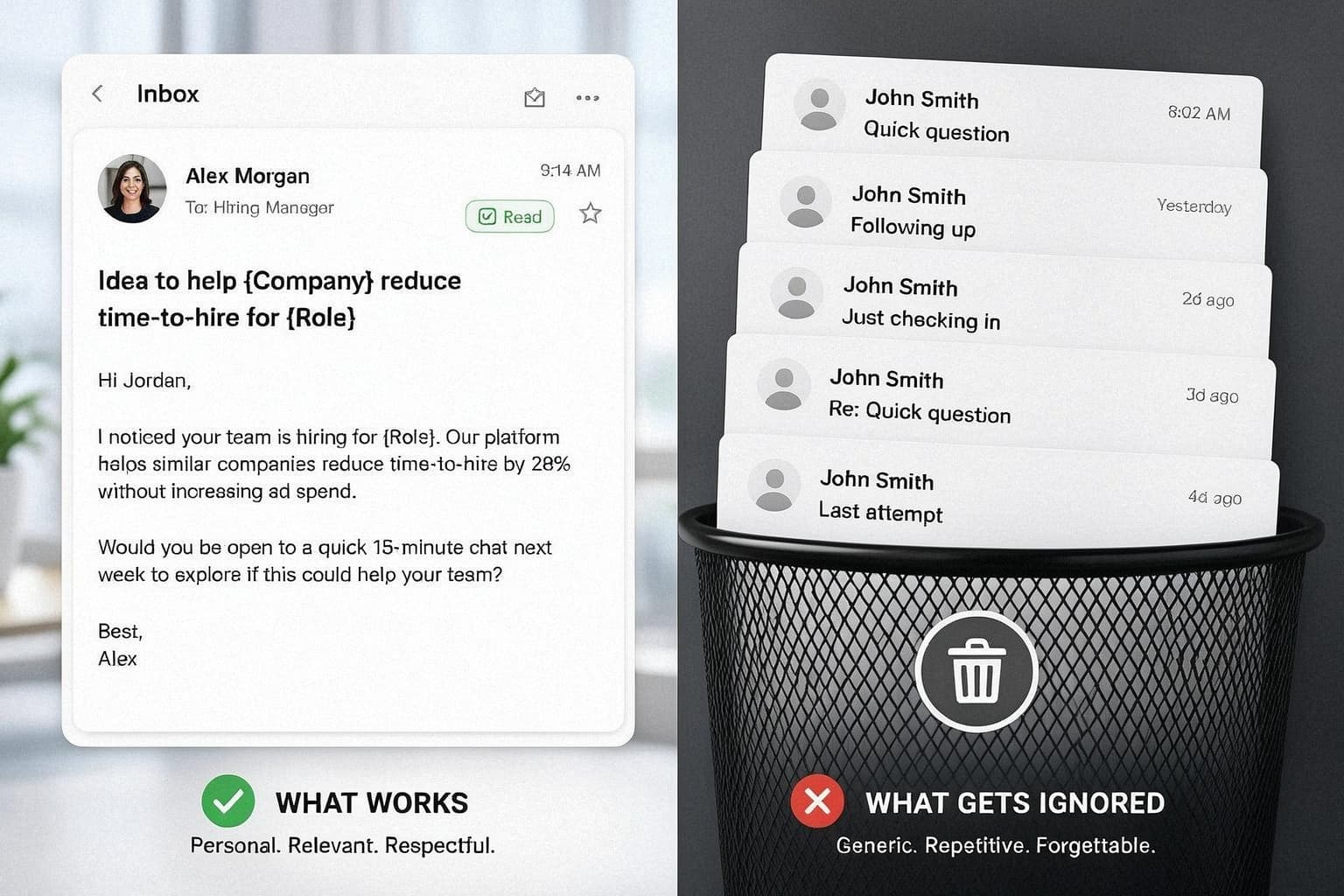
Most AI messages to hiring managers get ignored because they open with template enthusiasm and zero company-specific proof. Messages that work lead with one verifiable observation about the team or product, tie your background to a problem they actually work on, and close with a single low-friction ask in roughly 50 to 125 words. One timed follow-up reads as persistence; three unread notes read as pressure.
You already applied, or you found a role with no public listing, and you want to reach the person who can actually hire you. ChatGPT, Claude, and job-search AI tools make the first draft fast. The problem is not speed: hiring managers now see the same AI-pattern openers dozens of times per week. This article is an outcome ledger: what gets read, what gets deleted, and where the line sits between professional persistence and pushy spam. For the step-by-step de-robotizing workflow, see how to humanize AI cold email drafts. For verified contacts first, see finding the right stakeholder.
What should an AI message to a hiring manager include?
A working first touch has four parts: a specific hook tied to their company (not their mission statement), one proof point from your background that maps to their problem, a single low-friction ask (a 15-minute call, not "pick a time on my calendar"), and a plain sign-off from a real person. Generate the draft with AI if you want; edit until every sentence could only apply to this manager at this company.
- Hook: Reference something concrete: a product launch, a blog post, a stack choice, a hiring post they wrote. Not "I admire your innovative culture."
- Proof: One outcome with a number or scope, linked to what their team builds.
- Ask: "Would a 15-minute call next week be useful?" beats "I would love the opportunity to discuss how I can add value."
- Subject line: Role plus one specific hook; avoid "Quick question" and "Experienced [title] seeking opportunities."
The full structure lives in our cold email framework for recruiters and hiring managers.
What makes hiring managers delete AI outreach in seconds?
Delete triggers cluster into five buckets: template openers ("I am excited to apply," "I am confident I am the perfect fit"), zero company-specific detail, resume pasted as the email body, superlative self-praise with no evidence, and formatting that screams mass blast (HTML newsletters, tracking pixels, attachments on touch one). Managers decide in under ten seconds on mobile; sentence one is the filter.
Employer surveys cited in 2026 outreach roundups (including ResumeGenius's 2025 hiring manager poll) report that a majority can spot unedited AI-generated application copy. The issue is not the tool; it is template output with no personal specifics.
- Instant-delete phrases: "proven track record," "passionate about," "dynamic team player," "please do not hesitate," "attached please find."
- Structural tells: Identical paragraph lengths, "I hope this email finds you well," capability lists with no "so what" for their team.
- Channel mistakes: LinkedIn connection requests that are just the cover letter; emailing
info@orcareers@when a named manager exists.
| Gets a read | Gets deleted |
|---|---|
| Opens with a company-specific fact you verified | Opens with "I am excited to apply for…" |
| 50 to 125 words, one clear ask | 400+ words or full CV pasted inline |
| Plain text, no attachment on touch one | PDF resume attached unsolicited |
| Sent to a named decision-maker | Blasted to jobs@ and five similar titles |
| One proof point tied to their problem | Generic capability list ("Python, leadership, Agile") |
| Subject: role + specific hook | Subject: "Opportunity" / "Quick question" / ALL CAPS |
How do you sound professional without being pushy?
Professional persistence is one well-timed follow-up after five to seven business days of silence. Pushy is a second or third bump on the same thread, guilt language ("just circling back again"), or escalating urgency ("I need a response by Friday"). In European hiring norms, direct but restrained beats American-style enthusiasm; one follow-up signals interest, three signal desperation.
- Persistence (good): Short note, acknowledges busy inbox, restates interest, offers exit ("Happy to leave it here if timing is off").
- Pressure (bad): "Following up on my previous two emails," calendar links without permission, mentioning other offers as leverage on touch one.
- After applying through a portal: Optional one-line reference ("I applied via your careers page on [date]; reaching out directly because…") without implying they ignored the portal.
One follow-up often captures busy managers who saw but did not answer the first note. See cold email reply rates for job seekers for planning math on replies and follow-up timing.
How long should the message be, and when should you follow up?
Keep the first message between 50 and 125 words. That is long enough for context and one proof point, short enough to read on a phone between meetings. Send one follow-up five to seven business days later if you have no reply. Do not rewrite the entire pitch in the follow-up; three sentences maximum.
TurnAndTurn, cited in outreach research roundups, reports personalized cold email around 40% to 50% response versus 2% to 3% for generic applications. interviewing.io documents one to two orders of magnitude more responses from cold outreach to hiring managers than from online applying alone. Treat the upper bands as what strong targeting can approach, not a guarantee on every send.
Auto-apply volume rarely converts at the same rate: community-tested batches often report roughly 0% to 1% meaningful response per 100 to 300 portal applications. At a 10% reply rate on targeted outreach, roughly ten well-researched emails might yield one conversation; at 5%, plan on twenty. Not every reply becomes an interview.
Can ChatGPT write a good message to a hiring manager?
ChatGPT and Claude are fine for a first draft if you supply the job description, your CV, and two or three verified company facts. They default to template enthusiasm and vague hooks unless you constrain them. Competitor tutorials from AIApply and CoverLetterCopilot focus on cover letters for portal applications; a hiring-manager cold email is shorter, more direct, and must survive a ten-second mobile scan.
- What raw ChatGPT gets wrong: invented familiarity, wrong company details if you did not paste research, the same opener as every other candidate using default prompts.
- Minimum input bundle: job description, your top three relevant bullets, two company facts, and a constraint: under 125 words, no clichés, one ask.
- Never skip: human review for factual accuracy. AI hallucinates project names and metrics.
For the adversarial review checklist, see humanizing AI cold email to hiring managers. This article stays focused on outcomes; that guide covers the editing mechanics.
How does a dual-AI draft-and-review loop help?
One model drafts from your CV, skills, and scraped company research; a second model reviews for template phrases, unsupported claims, and robotic rhythm before you send. That mirrors what strong candidates do manually, at scale, without pasting the same prompt into ChatGPT for every company.
PitchHired builds that loop into a full outreach workflow: a candidate brief generated from your CV and portfolio, company research from crawled site markdown, writer and reviewer agents on each draft, hiring-manager contact discovery via Hunter and Apollo enrichment, and plain-text sends from your Gmail via OAuth with business-hours scheduling, randomized delays, and daily caps tied to inbox warming. Every touch is logged from draft through scheduled to sent. Access runs on pay-as-you-go credit packs with transparent monthly pricing, not a recurring subscription you forget to cancel.
Frequently asked questions about AI messages to hiring managers
Should I tell a hiring manager I used AI to write the message?
No. Hiring managers care whether the note is specific and genuine, not which tool you used. Disclosing AI adds no value and can signal you did not edit the draft. PitchHired's writer and reviewer agents help you draft; the send still comes from your Gmail as your outreach.
How long should an AI message to a hiring manager be?
Aim for 50 to 125 words for a first touch: enough for one company-specific hook, one proof point from your background, and a single ask. Longer unsolicited notes from strangers rarely get read. If you need more room, you are probably repeating your CV instead of making one clear case.
What makes hiring managers ignore cold email from job seekers?
Delete triggers include generic openers ('I am excited to apply'), capability lists with no company context, superlative self-praise, attachments on the first touch, and copy that could apply to any employer. Managers also ignore repeated identical follow-ups and notes that read like mass-blast templates with a swapped company name.
Is it okay to follow up if a hiring manager does not reply?
One brief follow-up about five to seven business days later is standard professional persistence. Acknowledge their inbox load, restate interest without pressure, and offer a clean exit. A second or third follow-up on the same thread usually moves you from persistent to pushy, especially in European hiring cultures where direct but restrained outreach is the norm.
Can ChatGPT write a good message to a hiring manager?
ChatGPT can produce a usable first draft if you feed it the job description, your CV, and two or three company-specific facts. Raw output still opens with template phrases and vague enthusiasm. The gap is not generation; it is a separate review pass that strips robotic rhythm and checks every claim against your real background before anything sends from your inbox.
Ready to land interviews faster?
Stop uploading resumes to automated portals. Start pitching directly to hiring decision-makers today.
Get started