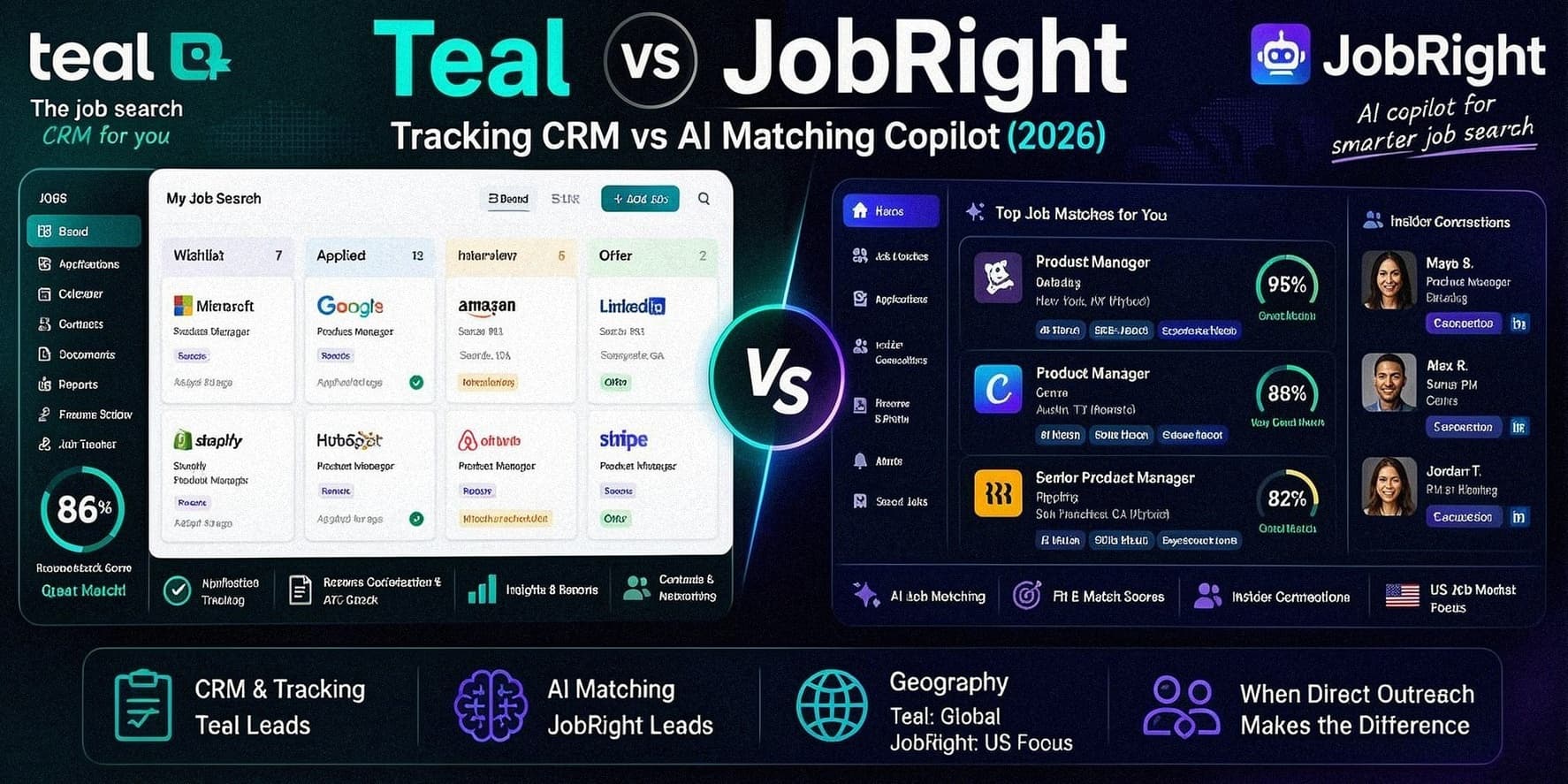
Teal is built around job-search CRM, resume-to-JD match scoring, and ATS diagnostics; JobRight is built around AI job discovery, fit scoring, Insider Connections, and US portal autofill. Neither sends verified hiring-manager cold email from your own Gmail. Pick Teal if your bottleneck is organizing applications and tailoring resumes; pick JobRight if your bottleneck is finding US roles and referral paths; pick direct outreach when reply rate matters more than portal throughput.
Most comparison pages lump Teal and JobRight as interchangeable "AI job search platforms." They are not. Teal optimizes what you submit: resume fit, ATS gaps, and pipeline hygiene. JobRight optimizes where you apply: discovery, match scores, referral hints, and autofill speed. The right choice depends on geography, whether you already know your target roles, and whether you are optimizing for application count or conversation count.
This page compares strategy and trade-offs, not resume-template aesthetics. For deeper context, read our Teal alternative guide, JobRight alternative guide, and whether JobRight is legit before you subscribe to either.
What is Teal and what is JobRight?
Teal is a job-search workspace: Chrome extension to save roles, kanban and table tracker, resume builder, job-description match score, structured ATS checker, LinkedIn profile reviewer, and networking CRM. JobRight is a US-focused AI copilot: a large listing index, AI Job Match, Orion assistant, Insider Connections from LinkedIn, portal autofill, and basic tracking. Different engines: organizer versus discovery copilot.
Teal's core bet is that many candidates lose interviews because their resume does not map cleanly to each posting, even when the role is a fit. JobRight's core bet is that many candidates lose time because they cannot find the right openings or warm referral paths in the first place. Third-party roundups often describe Teal as the stronger ATS diagnostic tool and JobRight as the stronger US discovery and referral research tool.
Teal vs JobRight: which is better for tracking applications vs finding roles?
Teal wins tracking depth: pipeline stages, notes, contact logging, follow-up reminders, and CRM-style networking fields. JobRight wins discovery: AI match scores, copilot Q&A, H-1B filters, and Insider Connections that surface alumni or former colleagues at target companies. If you already know your target companies, Teal reduces chaos. If you do not know where to apply, JobRight surfaces candidates faster, but only in the US and Canada.
Teal's kanban and table views replace spreadsheet chaos for high-discipline manual searchers. JobRight's tracker is lighter because the product steers you toward discovery-first workflows. The hidden cost differs: Teal still requires manual apply labor, often cited at 15 to 20 minutes per tailored application in third-party reviews. JobRight saves discovery time but still lands you in crowded ATS queues even when autofill is fast.
Which tool is better for resume and ATS optimization?
Teal is the stronger ATS diagnostic tool. Upload a job description, get a match score, see keyword gaps, and run a structured ATS checker with a transparent breakdown. JobRight tailors resumes to matched roles and autofills forms, but third-party comparisons note less measurable scoring than Teal and a real fabrication risk: JobRight's AI has been reported to insert skills or credentials candidates do not have, which our JobRight legitimacy review documents alongside billing friction themes.
Teal's most useful ATS features, including unlimited AI credits, advanced keyword insights, and cover-letter generation, sit behind Teal+ pricing that third-party reviews commonly cite at about $29 per month, $13 per week, or $79 per quarter. JobRight's free tier offers limited daily AI credits; Turbo removes daily caps at about $39.99 per month in 2026 pricing roundups. Neither replaces humanized cold email copy; see our guide to humanizing AI cold email to hiring managers.
| Dimension | Teal | JobRight |
|---|---|---|
| Primary strategy | Job-search CRM: track pipeline, tailor resume to each JD, close ATS keyword gaps | AI copilot: aggregate listings, score fit, surface Insider Connections, autofill US portals |
| Automation level | Low: manual apply; autofill extension on 40+ boards; no auto-apply engine | Medium: autofill plus assisted apply narratives; user often approves submissions |
| Geography | Global; EU-friendly organizer | US and Canada only |
| Outreach channel | Networking CRM for contacts you add; no scaled cold email to decision-makers | Insider Connections and referral hints; not verified hiring-manager cold email at scale |
| Resume / ATS tooling | Match score, keyword gaps, structured ATS checker, LinkedIn profile reviewer | AI resume tailoring per role; less transparent scoring; manual audit required |
| Job discovery / matching | Aggregates listings; no AI match engine as core product | AI Job Match from large US index; H-1B filter; Orion copilot Q&A |
| Tracking / CRM | Kanban plus table pipeline; contact logging; follow-up reminders | Basic dashboard tracker; discovery-first UX |
| Pricing model | Free tier for tracking; Teal+ ~$29/mo, $13/wk, $79/qtr per third-party reviews | Free daily AI credits; Turbo ~$39.99/mo ($17.99/wk, ~$89.99/qtr cited in reviews) |
| Documented risks | AI bullets can sound generic; useful ATS features behind Teal+ paywall; manual apply fatigue | Billing and cancel friction; AI credential fabrication; US-only scope |
| Best for | Candidates who want pipeline visibility and measurable resume-to-JD fit before each apply | US candidates who need role discovery, referral research, and autofill on US ATS portals |
Which is better for direct outreach to hiring managers?
Neither is built for verified hiring-manager cold email from your Gmail. Teal helps you log contacts and follow-ups you initiate manually. JobRight helps you find warm referral paths from your LinkedIn graph, not concise decision-maker outreach at scale. For cold outreach, you need company research, the right stakeholder, and a short personalized note sent via OAuth from your inbox with paced scheduling.
The strategy gap shows up in reply data, not vendor marketing. Research aggregated by interviewing.io suggests cold outreach to hiring managers can produce responses at one to two orders of magnitude higher rates than online applying alone. TurnAndTurn cites personalized cold email reply rates around 40 to 50 percent versus 2 to 3 percent for generic applications. Best-practice cold notes stay around 50 to 125 words, with one follow-up at five to seven days. Neither Teal nor JobRight optimizes that funnel; both keep you in portal and spreadsheet workflows.
For finding the right person before you write, read how to find the right stakeholder and how to bypass ATS with direct recruiter outreach.
How do Teal and JobRight pricing compare in 2026?
Teal offers a usable free tier for tracking, with unlimited job tracking commonly cited in third-party reviews, and Teal+ at roughly $29 per month, $13 per week, or $79 per quarter. JobRight offers limited free daily AI credits and Turbo at about $39.99 per month, with weekly and quarterly options cited around $17.99 per week and $89.99 per quarter. Teal is cheaper monthly; JobRight costs more but bundles US discovery and autofill.
When describing competitor pricing, note their free tiers by name only. Teal's free plan and JobRight's free daily credits are their offers, not PitchHired's model. PitchHired runs on pay-as-you-go credit packs. JobRight's billing friction is well-documented in one-star reviews; our JobRight legitimacy review cites cancellation complaints in roughly 72 percent of those reviews. For a broader pricing-model comparison, see job search credits versus subscriptions.
Which should you choose: Teal, JobRight, or direct Gmail outreach?
Choose Teal if you apply manually, need pipeline CRM, and want measurable resume-to-JD fit. Choose JobRight if you are US or Canada only, need discovery and referral research, and will audit every AI resume line. Choose direct Gmail outreach if interviews stall despite optimized portal applications; reply rate beats application count.
For European readers, JobRight is disqualified on geography alone. Teal organizes an EU search but does not replace direct, role-specific professional email norms. See how to apply for jobs in Europe for country-level context. A simple decision matrix:
- Choose Teal if: your bottleneck is resume fit and pipeline visibility, your search is global or EU-focused, and you accept manual apply labor.
- Choose JobRight if: your search is US-only, you need discovery and referral research, and you will verify every AI-written resume line before submitting.
- Choose direct outreach if: you need conversations with decision-makers, not just better spreadsheets or faster portal forms.
When does direct Gmail outreach beat both tools?
When you need replies, not just submissions, direct outreach from your authenticated Gmail beats CRM hygiene and portal autofill. PitchHired targets verified decision-makers, drafts with a dual-AI writer and reviewer loop, researches the company from scraped markdown, and schedules sends in business-hour windows with daily caps and inbox warming tiers.
- Candidate brief from your CV. An AI-generated profile from your skills, portfolio, and uploaded CV grounds every message in your real background.
- Hiring Manager Finder. Lead targeting through Hunter and Apollo enrichment identifies the right stakeholder, not a random recruiter inbox.
- Dual-AI email loop. A writer agent drafts; a reviewer agent critiques before anything is scheduled.
- Gmail OAuth delivery. Messages send from your own inbox with SPF, DKIM, and DMARC alignment inherited from Google's infrastructure.
- Paced, scheduled sends. Business-weekday windows, randomized delays between sends, and daily caps tied to inbox warming reduce deliverability risk.
- Outreach event ledger. Draft, scheduled, and sent rows give you a clear audit trail per recipient.
Teal vs JobRight: frequently asked questions
Is Teal or JobRight better for European job seekers?
Teal is the practical choice between the two in Europe because its CRM and resume tools are geography-agnostic. JobRight is restricted to the US and Canada, which disqualifies it for most Germany, Netherlands, or broader EU searches regardless of feature quality. Neither replaces GDPR-conscious direct outreach to verified hiring managers from your own Gmail inbox.
Does Teal or JobRight send cold emails to hiring managers?
Neither product is built for verified hiring-manager cold email at scale. Teal includes a networking CRM to log contacts and follow-ups you initiate manually. JobRight emphasizes Insider Connections and referral paths from your LinkedIn network, not concise decision-maker outreach from your Gmail. If your goal is a short, role-specific note to the actual hiring manager, that is a different workflow than either CRM or copilot.
Which is better for resume optimization: Teal or JobRight?
Teal is stronger on transparent resume-to-job-description fit: upload a JD, get a match score, and see keyword gaps plus structured ATS checks. JobRight tailors resumes per matched role but offers less measurable scoring and requires manual review because its AI has been reported to insert skills or credentials candidates do not have. For ATS keyword discipline, Teal wins; for speed through US portals after tailoring, JobRight can save time if you audit every line.
Is Teal or JobRight worth paying for in 2026?
Pay Teal+ if you apply manually at steady volume and need match scoring, ATS diagnostics, and pipeline tracking in one workspace. Pay JobRight Turbo if you are US-based, rely on its matching and autofill, and accept subscription billing with documented cancellation friction. Skip both paid tiers if your bottleneck is reaching the right hiring manager with credible copy; contact discovery plus personalized Gmail outreach solves a different problem than more portal submissions or better spreadsheets.
Ready to land interviews faster?
Stop uploading resumes to automated portals. Start pitching directly to hiring decision-makers today.
Get started