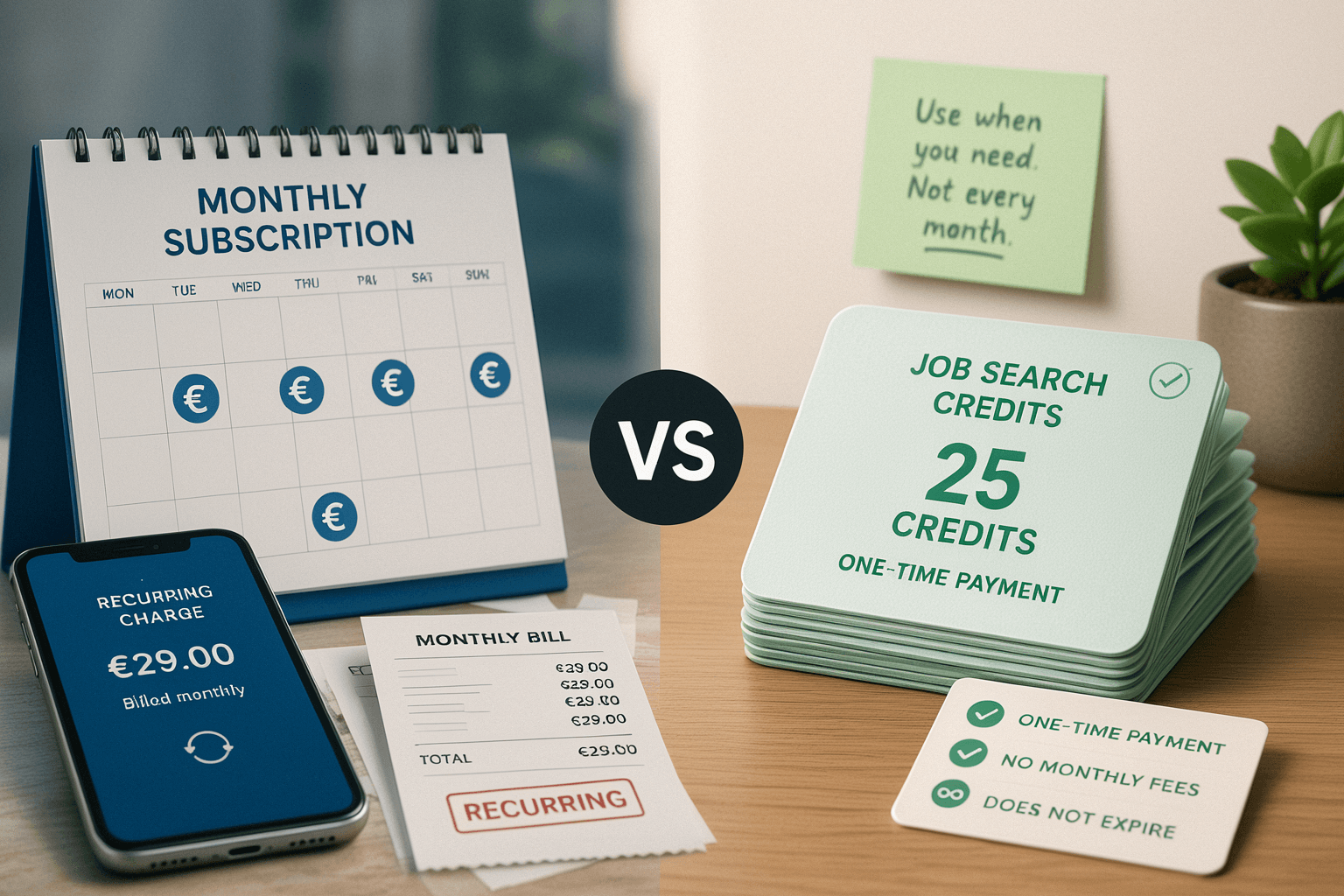
Monthly subscriptions (Teal, LoopCV, Sonara, JobRight) fit a 4–8 week sprint you will actively cancel; one-time credit packs (LazyApply-style application bundles, PitchHired outreach credits) fit bursty searches and fixed budgets. Over a typical three-month search, uncanceled subscriptions often cost €75–120 or more; one-time packs front-load spend but remove renewal risk and can be cheaper if your search pauses. Pick subscriptions for daily trackers and portal volume; pick credits when you want predictable outreach spend with no recurring bill.
Every job seeker hits the same billing fork: another €29/month tab, or one checkout and done. This page compares pricing models, not a single vendor shootout. Subscriptions buy calendar time. Credits buy units of work. The right choice depends on how long your search runs, whether you will remember to cancel, and whether you need a daily workspace or a finite batch of hiring-manager emails.
If you are already comparing named tools, start with our LoopCV alternative guide and Sonara alternative guide for how recurring auto-apply billing stacks up against direct Gmail outreach. A fuller 2026 vendor price roundup ships separately; here the focus is the decision framework.
What is the difference between job search subscriptions and pay-as-you-go credits?
Subscriptions buy calendar time: access to a platform until you cancel. Credits buy units of work: applications submitted, emails sent, or AI generations consumed. Subscriptions reward daily use during an active sprint. Credits reward knowing your volume upfront and pausing without a recurring charge.
Teal illustrates the split. Its free tier covers unlimited resume creation and job tracking with limited AI credits; Teal+ is a subscription (third-party 2026 reviews cite roughly $29/month, $79/quarter, or $13/week depending on billing cycle) for unlimited AI tailoring and match scoring. PitchHired uses the opposite shape: one-time packs at €18, €37, and €59 for 60, 180, and 400 outreach credits with no monthly clock. One credit equals one personalized email sent to a hiring decision-maker. LazyApply sits in between with one-time application bundles ($99–$249 in third-party reviews) rather than monthly access. Application credits and hiring-manager email credits are not interchangeable metrics.
When should you pay monthly for a job search tool?
Pay monthly when you need a daily workspace for 30+ active applications, resume tailoring, or continuous auto-apply, and you will set a cancel date the day you accept an offer. Subscriptions are rational for a defined sprint, not an open-ended search you might pause for weeks.
- Trackers and CRM tools (Teal, Huntr). Worth a paid month when you are juggling many parallel applications and need version-controlled resumes and status columns daily.
- Auto-apply copilots (LoopCV, Sonara, JobRight). Monthly tiers make sense when portal volume is your strategy and you accept the deliverability trade-offs. See LoopCV pricing context and Sonara billing complaints before you commit.
- Billing-cycle traps. Teal's weekly plan annualizes to far more than its quarterly option in 2026 reviews. Pick the longest cycle you are comfortable prepaying, then cancel aggressively.
Competitor free tiers (Teal's free tracker, LoopCV's limited free applications, JobRight's daily credit pool) are their offers, not PitchHired's model. PitchHired runs on pay-as-you-go credit packs only.
When do one-time credits beat a subscription?
Credits win when your search is uneven (weeks off between bursts), you want a fixed cash cap, or you only need a finite outreach batch to hiring managers rather than unlimited platform access for a calendar month.
Subscription fatigue is common in auto-apply categories. Sonara's paid trial often renews around $23.95 every four weeks on higher tiers, and user reports of six-month spend approaching $600 show what happens when renewals outlive the search. Our Sonara alternative breakdown walks through that pattern. LazyApply's one-time tiers ($99 Basic, $149 Premium, higher Ultimate tiers in third-party reviews) remove the monthly renewal but still optimize application count, not verified manager conversations. See LazyApply pricing and risks for detail.
Direct outreach credits fit a different job: a bounded set of researched emails to people who can hire you. Named data cited on PitchHired suggests personalized cold email to hiring managers can outperform high-volume portal applying; read cold email reply rates for job seekers for the benchmarks. Sixty well-targeted emails often beat three hundred anonymous portal submissions, which changes how you should think about per-unit pricing.
How much does each pricing model cost over a 3-month job search?
Three uncanceled months at €29/month is roughly €87 before tax. Three months at €40/month is roughly €120. Entry one-time packs often land €18–59 (PitchHired outreach packs) or $99+ (LazyApply application bundles), but they cap different activities. This is not apples-to-apples math; it is cash-out-the-door math.
Third-party 2026 roundup ranges for subscription tools commonly cluster as follows (verify on each vendor site before purchase): JobCopilot about $15–19/month, LoopCV about $19–24.90/month, Sonara about $25–80/month depending on tier, Teal+ about $29/month, JobRight Turbo about $29.99–39.99/month. Multiply by the months you will actually stay subscribed.
- Scenario A: six-week sprint, cancel on time. One or two months of Teal+ or LoopCV can cost less total cash than a large credit bundle you underuse. Subscriptions win on short, intense tracker or auto-apply use.
- Scenario B: nine-month search with a two-month pause. Credits avoid idle billing while you travel, study, or wait on visas. PitchHired credits do not expire; subscription tools keep charging unless you cancel.
- Scenario C: outreach batch only. A €18 Sprint pack (60 hiring-manager emails) or €37 Launch pack (180 emails) may cost less than three months of any subscription if your bottleneck is conversations, not form speed. Check live prices on PitchHired pricing before checkout.
| Dimension | Monthly subscription | Pay-as-you-go / one-time credits |
|---|---|---|
| Billing rhythm | Recurring weekly or monthly until you cancel | Single checkout; optional top-up packs later |
| Best for | Daily trackers, resume tailoring sprints, portal auto-apply | Fixed budget, pausable search, direct outreach batches |
| Typical 3-month cost | Often €75–120+ if not canceled (€25–40/mo tools) | LazyApply $99–249 one-time; PitchHired €18 / €37 / €59 packs (credits never expire) |
| Cancellation risk | Auto-renew after trials; weekly billing traps on some tiers | No subscription to cancel; unused units may sit idle |
| Search pause | You still pay while paused unless you cancel | Credits remain; no monthly bleed on PitchHired |
| Value metric | Time-bounded access (features in tier) | Usage-bounded (per application, per email, per AI action) |
| Example tools | Teal, LoopCV, Sonara, JobRight, JobCopilot | LazyApply, AIApply credit packs, Rezi lifetime (resume-only), PitchHired |
Which job search tools use subscriptions vs one-time credits in 2026?
Most auto-apply and tracker copilots bill monthly. A smaller set sells lifetime or credit packs for applications or outreach. Match the tool to the job: track active pipelines, blast portal forms, or email verified hiring managers. Mixing categories on price alone leads to the wrong purchase.
Subscription-heavy: Teal and Huntr for organization; LoopCV, Sonara, JobRight, and JobCopilot for automated or semi-automated applying. One-time or credit-pack models: LazyApply for capped daily applications; AIApply for credit-based auto-apply; Rezi's lifetime plan as a resume-builder outlier; PitchHired for hiring-manager email outreach where one credit equals one sent message from your Gmail via OAuth.
How does PitchHired pricing fit the credit model?
PitchHired is built for candidates who want verified decision-maker outreach, not another monthly portal subscription. Shipped behavior today:
- One-time Stripe credit packs. No subscription. Pay once per pack through checkout.
- 1 credit = 1 email sent. Each credit reaches one hiring decision-maker, not a generic careers inbox.
- Credits never expire. Unused credits stack when you buy more packs.
- Dual-AI writer and reviewer. A writer agent drafts; a reviewer agent critiques before scheduling.
- Company research and lead targeting. Crawled company markdown feeds a research agent; Hunter and Apollo enrichment finds stakeholders.
- Gmail OAuth sending. Plain-text mail from your inbox with paced business-hour windows, randomized delays, and daily caps tied to inbox warming.
- Outreach event ledger. Draft, scheduled, and sent rows per recipient for a clear audit trail.
See current pack prices on PitchHired pricing before you purchase. If subscriptions never fit your search shape, credits are the wedge; if you need a daily tracker for sixty parallel applications, pay for that month and cancel on schedule.
Job search credits vs subscriptions: frequently asked questions
Are job search tool subscriptions worth it?
Subscriptions are worth it when you will use the tool daily for a defined sprint and set a cancel reminder. Teal+ (~$29/month in 2026 reviews), LoopCV Pro (~$20–25/month), and Sonara (~$24–50/month depending on tier) make sense for 4–8 weeks of heavy tracking or auto-apply. They are a poor deal if your search pauses for a month while billing continues, or if you only need a finite batch of outreach emails rather than ongoing platform access.
Do job search credits expire?
It depends on the vendor. Many auto-apply tools sell one-time bundles with application caps (for example LazyApply tiers from $99 upward) that do not renew monthly. PitchHired credits do not expire: you pay once per pack, unused credits stack when you buy more, and there is no subscription clock. Always read the billing page: some products mix credit packs with separate monthly platform fees.
What is cheaper for a 3-month job search: subscription or credits?
If you cancel on time, one month of a €29 subscription may beat a large one-time bundle you barely use. If you run a full 3-month search without canceling, three months at €25–40/month often exceeds €75–120, while entry one-time packs (PitchHired Sprint at €18 for 60 emails, or LazyApply Basic at $99 for capped daily applications) can cost less total cash. Credits win when your search is bursty or you fear forgotten renewals; subscriptions win for a short, intense sprint with daily tracker use.
Does PitchHired require a subscription?
No. PitchHired sells one-time credit packs only through Stripe checkout. One credit equals one personalized email sent to a hiring decision-maker from your connected Gmail. There are no monthly fees, and credits never expire. See live pack prices on the site pricing section before purchase.
Ready to land interviews faster?
Stop uploading resumes to automated portals. Start pitching directly to hiring decision-makers today.
Get started