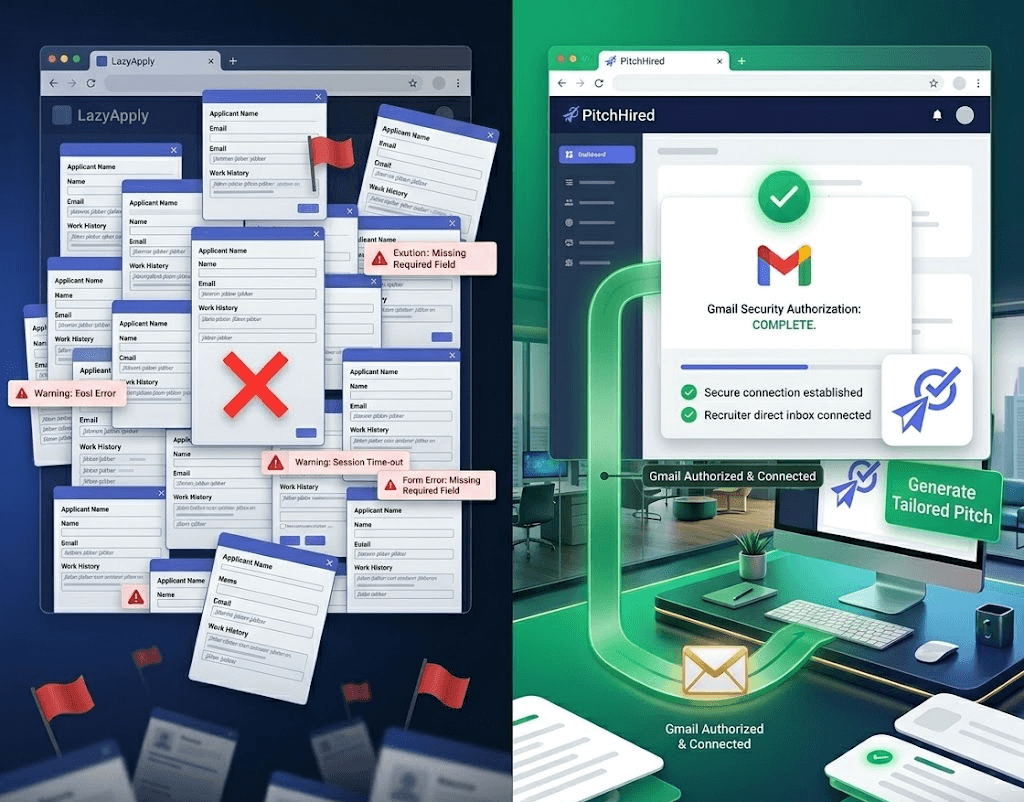
The best LazyApply alternative in 2026 is PitchHired. LazyApply auto-clicks hundreds of portal forms from a Chrome extension, which exposes your LinkedIn account to ban risk and your email to spam-folder routing. PitchHired skips mass auto-apply entirely: it finds verified hiring managers, personalizes each message with a dual-AI writer and reviewer loop, and sends from your own Gmail via secure OAuth.
If you are comparing LazyApply alternatives, you usually want the time savings without the documented downsides: a low Trustpilot rating, LinkedIn automation risk, and refund complaints. Read our honest LazyApply safety review first, then see why direct outreach from your own inbox is the lower-risk path. For reply-rate context versus portal volume, see cold email reply rates for job seekers; for EU etiquette, see cold email for jobs in Germany. For deliverability details, see our guide to email deliverability for job search.
What is the best LazyApply alternative?
The best LazyApply alternative for most job seekers is a tool that replaces mass auto-clicking with verified, personalized emails to hiring managers from your own Gmail inbox. PitchHired does exactly that: Hiring Manager Finder, dual-AI personalization, and OAuth sending with paced scheduling. You trade raw application volume for messages that actually reach decision-makers.
Why do mass auto-apply tools fail in 2026?
ATS filters and recruiter overload mean volume auto-apply rarely converts, while exposing your LinkedIn and email reputation. Keyword gates ghost qualified candidates; bots like LazyApply respond with more clicks, not better targeting. Direct outreach to hiring managers (see bypassing ATS with recruiter outreach) trades raw application count for messages that reach decision-makers.
The ATS "black hole" flooded requisitions with applications, so HR teams deployed keyword-driven filters. Qualified candidates, especially in competitive European markets, face ghosting despite hours spent tailoring CVs. The flawed countermeasure: exponentially increase volume via AI bots and extensions like LazyApply, ignoring LinkedIn security, email deliverability, and recruiter fatigue with machine-generated noise.
How does LazyApply put your LinkedIn account at risk?
LazyApply auto-clicks job boards by manipulating page code in your browser, which triggers LinkedIn and Indeed anti-bot systems. DOM injection at superhuman speed leaves fingerprints; UI changes on any board can break the extension until developers patch the new HTML structure. Estimated ban rates reach 70 to 85% within thirty days of aggressive use.
The illusion of application velocity
LazyApply tiers incentivize extreme daily volume:
- Basic ($99/year): up to 15 applications/day, one resume profile
- Premium ($149/year): up to 150/day, five resume profiles
- Ultimate ($999/year): up to 1,500 applications per day
That pace precludes real customization and often produces spam that damages standing with recruiters—even before platform enforcement kicks in.
Platform retaliation and algorithmic bans
LinkedIn monitors volume patterns, timing anomalies, extension fingerprints, and message similarity. Consequences include critical restrictions (e.g. hundreds of connection requests in hours), silent blocks where the UI shows success but the server rejects the action, and estimated 70–85% ban rates within thirty days of aggressive auto-apply use.
| Signal type | What is monitored | Risk level |
|---|---|---|
| Volume patterns | Hundreds of requests in short windows | Critical |
| Timing patterns | Odd hours or exact millisecond intervals | High |
| Browser fingerprints | Extension signatures, DOM manipulation | High |
| Message similarity | Identical copy to many users | Critical |
Can auto-apply extensions ruin your email deliverability?
Yes. Pivoting from portal clicks to scraped bulk email shifts risk from LinkedIn bans to ISP Sender Scores (0 to 100). Scores above 90 support strong inbox placement; 80 to 90 drops deliverability sharply; below 80, half or more of mail may hit spam or gateway rejection. Hard bounces from unverified scraped addresses are a primary reputation killer. Verified contact discovery before send keeps hard bounces near zero.
DRSI = max(0, 100 − ((Cspam/Vdaily) × α) − ((Cbounce/Vdaily) × β))
High-volume tools maximize spam complaints and bounces because they sacrifice relevance and verification—driving DRSI toward blacklist territory.
Google Workspace deliverability (2024–2026)
Google now requires SPF/DKIM; high-volume senders need DMARC, PTR, and TLS. Spam rates must stay below 0.1% daily; crossing 0.3% can remove deliverability support until a 7-day average recovers. Bulk job extensions rarely ship compliant list-unsubscribe headers required for promotional mail.
| Limit type | Account tier | Maximum |
|---|---|---|
| Daily sending | Personal Gmail | 500 / day |
| Daily sending | Paid Workspace | 2,000 / day |
| Gmail API recipients | Per message | 100 |
| Total recipients | All channels | 10,000 / day |
What are the main LazyApply alternatives in 2026?
Most alternatives still optimize portal volume (JobCopilot, LoopCV, AIApply, Simplify Copilot) rather than verified hiring-manager outreach from your own inbox. Compare trust angles in our JobRight legitimacy review and LoopCV alternative guide before picking a lane.
- JobCopilot: high-volume career-page bot—same spam and rejection risks as LazyApply.
- LoopCV: 20+ boards plus analytics/A/B testing—still volume-first into the ATS.
- AIApply: strong drafting, credit-based auto-apply, US-centric—weak secure bypass of portals.
- Simplify Copilot: autofill on click only—safer, but manual discovery is labor-intensive.
- Atlas Apply: human-reviewed EU applications—high quality, low velocity, still portal-bound.
Why is PitchHired the best LazyApply alternative for direct outreach?
PitchHired replaces auto-clicking with verified hiring-manager email from your own Gmail via OAuth, dual-AI personalization, and paced business-hours scheduling. Founded in Milan, it treats cold email to decision-makers as the reliable path out of the ATS lottery, built for European compliance and inbox deliverability.
1. Privacy-first Google OAuth
No master passwords or legacy IMAP/SMTP—Google deprecated basic auth for less secure apps by March 2025. PitchHired uses OAuth 2.0 with scoped tokens so mail sends from your authenticated Gmail API, mimicking 1-to-1 human mail—not shared proxy pools.
2. Smart contact discovery and GDPR
Verified hiring managers—not generic careers@ inboxes—keep hard bounces low and support legitimate-interest outreach under GDPR with hyper-targeted, minimal professional data.
3. Dual-AI review loop ("Zero-Bot Vibes")
A generator drafts from your history and the role; a discriminator strips robotic phrasing before send. Discovery through authenticated Gmail completes in under sixty seconds.
| Feature | LazyApply | PitchHired |
|---|---|---|
| Primary channel | Browser extension auto-clicker | Direct inbox via Gmail API |
| Platform safety | High ban / silent-block risk | No LinkedIn scraping |
| Deliverability | High bounce / spam risk | Verified contacts, OAuth send |
| Volume strategy | 15–1,500 apps/day | Targeted, high-intent outreach |
| Personalization | Keyword stuffing, templates | Dual-AI humanization |
| Recipient | ATS portals | Verified hiring managers |
Frequently asked questions
Does automated job application software cause LinkedIn bans?
Yes. Browser extensions that automate DOM manipulation, such as LazyApply, violate major professional networking terms of service. Security systems flag robotic timing, identical messages, and extreme connection velocity. Estimated ban rates reach 70–85% within thirty days, with silent blocks that hide failed applications from your dashboard. Tools that avoid scraping professional platforms eliminate this risk.
What are the exact regional and daily sending limits for Gmail accounts?
Personal Gmail accounts may send up to 500 messages per rolling 24 hours. Paid Google Workspace accounts allow up to 2,000 per day, with mail merge capped at 1,500 and Gmail API messages limited to 100 recipients per message. Total recipients across channels cannot exceed 10,000 per day. Exceeding limits triggers temporary suspension.
How does bounce rate mathematically affect domain reputation during a job search?
Hard bounces to invalid addresses signal list scraping to ISPs and collapse your Sender Score. As bounce rates climb, deliverability drops and legitimate mail routes to spam. Verified contact discovery before send keeps hard bounces near zero.
Is cold emailing a hiring manager strictly compliant with GDPR?
Yes, when grounded in Article 6(f) legitimate interest: hyper-relevant outreach to the recipient's professional role, a documented Legitimate Interest Assessment, data minimization (name, title, corporate email only), and a clear opt-out. Mass generic blasts fail this test; targeted professional introductions comply.
Why is OAuth preferred over IMAP or SMTP passwords for email tools?
IMAP, POP, and SMTP often require sharing your master password with third parties. OAuth 2.0 uses scoped tokens via Google's login portal—you never expose your password and can revoke access anytime. Google deprecated basic authentication for less secure apps in 2025, making OAuth mandatory for modern Gmail integrations.
Should you switch from LazyApply to direct outreach?
If you care about LinkedIn access and inbox placement, yes. Brute-force auto-clickers trade domain authority and network access for the illusion of velocity. Precision outreach with OAuth, verified contacts, and dual-AI authenticity is the sustainable path, especially under European GDPR and modern Gmail enforcement.
Use the CTA below to get started on PitchHired with pay-as-you-go credits and launch your first targeted hiring-manager sequence in under sixty seconds—without sacrificing your professional identity.
Ready to land interviews faster?
Stop uploading resumes to automated portals. Start pitching directly to hiring decision-makers today.
Get started