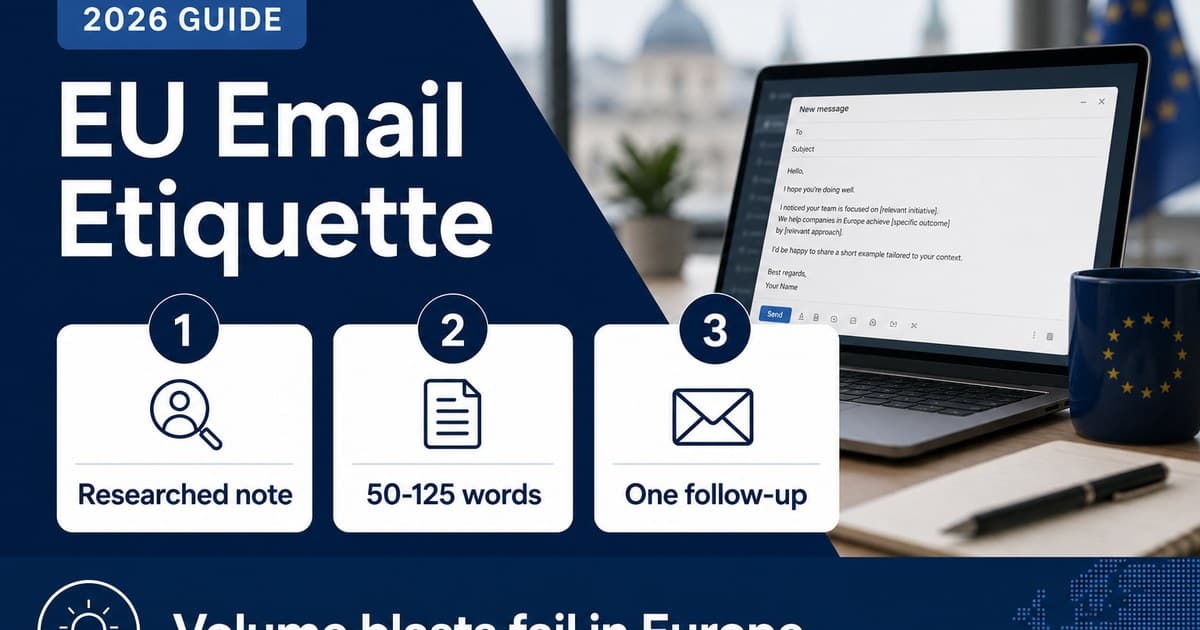
European hiring managers ignore US-style application blasts because volume templates fail European job search email etiquette. High send counts, superlatives, and chase sequences that feel normal in some US markets read as spam in Munich, Amsterdam, Lyon, or Stockholm. Replace the blast with short, company-specific notes to verified managers, paced from your own Gmail.
Candidates who import US auto-apply loops and five-touch sales cadences into Europe often conclude that "cold email does not work here." Usually the channel is fine; the style is wrong. European teams hire through referrals, Initiativbewerbung, and quiet outreach long before a role saturates LinkedIn. The same inbox that will open a 90-word, evidence-led note will archive a mass template without reading past the first sentence.
This guide explains why blasts get ignored, what European job search email etiquette actually requires, and how to rebuild outreach around selectivity. For country-level detail, see cold email for jobs in Germany and cold email for jobs in the Netherlands. For the wider continental frame, start with how to apply for jobs in Europe.
Why do European hiring managers ignore US-style application blasts?
They ignore blasts because the signals scream bulk, not fit. A manager scanning mail between standups filters for relevance in seconds. Generic openers ("I am passionate about your mission"), inflated adjectives, and identical paragraphs across peers look like campaign copy. In tight European professional networks, that pattern travels: one bad blast can poison a cluster of related companies.
US-style volume assumes more attempts equal more luck. European etiquette assumes fewer, better attempts equal respect for the recipient's time. When your first line could apply to any SaaS company on the continent, the message has already failed the etiquette test. Managers also receive more automated apply packets than they did five years ago; they have learned to ignore anything that feels machine-scaled.
Direct outreach still works when it is specific. interviewing.io reports that cold outreach to hiring managers done right can yield one to two orders of magnitude more responses than online applying alone. That gap assumes research and personalization, not a shared template fired at 200 addresses.
What is European job search email etiquette?
European job search email etiquette is short, evidence-led, and low-pressure. Lead with why you contacted that team, give one concrete proof point, ask for a small next step, and stop after one follow-up if there is no reply. Keep tone modest; let results do the selling. Source work emails from professional channels and keep batches proportionate under GDPR-aware practice.
| Dimension | US-style blast | European expectation |
|---|---|---|
| Volume | 50 to 100+ similar emails per week | 15 to 25 researched contacts; selectivity over scale |
| Opening | Candidate ambition and enthusiasm first | Company or team context first, then you |
| Tone | Superlatives and sales energy | Modest, factual, easy to skim |
| Length | Long cover-letter paste or multi-CTA pitch | Roughly 50 to 125 words, one ask |
| Follow-up | Every 2 to 4 days, multi-touch sequences | One follow-up after 5 to 10 business days |
| Seasonality | Year-round push regardless of calendar | Avoid early August and late December windows |
Etiquette is not one monolith. Dutch notes can be blunt and informal; German Initiativbewerbung often expects a clearer application framing and cleaner attachments. Nordic and French norms sit somewhere between. The shared rule across markets: do not sound like a US sales sequence. Country guides help you tune language and formality without changing the core: relevance, brevity, proof.
How does volume outreach break European inbox trust?
Volume breaks trust before anyone evaluates your skills. Shared templates bounce through LinkedIn and Slack. Wrong titles and unverified addresses create bounce noise that hurts deliverability for later, better sends. Aggressive chase cadences mark you as someone who will not take a soft no. In markets where silence often means "not now," pressure reads as poor judgment.
Auto-apply compounds the problem. Community-tested batches frequently report roughly 0% to 1% meaningful replies per 100 to 300 portal applications. That math trains candidates to send more of the same. European managers experience the other side: identical CVs, identical cover letters, and identical "quick questions" landing in the same week. When you then add a US-style cold email blast on top, you look like another automation layer, not a peer.
GDPR shapes expectations too. Professional contact to a work email about a role-relevant topic can be proportionate when sourced carefully and easy to opt out of. Buying opaque lists and blasting hundreds of contacts fails both privacy practice and etiquette. Keep logs, honour stop requests, and prefer enrichment tools that return work addresses tied to a real title. For finding the right person before you write, see how to find the hiring manager's email.
What should you write instead of a blast template?
Write one researched note per contact, then reuse the structure, not the sentences. Open with a company-specific observation (product, team post, open role signal). Add one credential that maps to that observation. Close with a single low-friction ask: a 15-minute chat, a pointer to the right person, or permission to send a short PDF. Aim for 50 to 125 words.
- Target decision-makers, not every recruiter alias on the careers page. Hiring managers are incentivized to fill roles; generic HR inboxes are optimized to filter noise.
- Personalize with real common ground. interviewing.io's templates put deep personalization in the highest reply band (roughly 25% to 50% when the tie-in is genuine). Treat that as an upper band for strong research, not a promise on every send.
- One follow-up only. Wait 5 to 7 business days for cold email (closer to 7 to 10 in more formal markets). Keep the chase under 60 words. A third message usually costs more goodwill than it recovers. Timing detail lives in our follow-up email timing guide.
- Respect the calendar. Early August in much of Western and Southern Europe, and mid-December through early January, are poor windows for expecting fast replies.
- Use AI as a draft aid, not a blast engine. A writer pass still needs a reviewer pass so the note does not sound like ChatGPT. See humanizing AI cold email and AI messages to hiring managers.
Roles that never hit boards are often filled through this quieter path. If your strategy is still "apply to everything posted," pair outreach with hidden job market tactics instead of raising blast volume. Reply-rate benchmarks and planning ranges are covered in cold email reply rates for job seekers.
How can PitchHired help without turning outreach into a blast?
PitchHired is built for targeted hiring-manager email from your own inbox, not shared bulk sending. Company research from scraped site markdown feeds a dual-AI writer and reviewer loop so drafts stay role-specific. Lead targeting uses Hunter and Apollo enrichment to find relevant contacts. You send plain text via Gmail OAuth, with business-hours windows, randomized delays between sends, daily caps, and an outreach event ledger from draft to scheduled to sent. Pricing is pay-as-you-go credit packs.
That stack matches European etiquette: fewer, better messages, paced like a human, from an authenticated personal or Workspace mailbox. It will not fix a US-style template if you paste one in. It will help you research, draft, review, and schedule the kind of note European managers are more likely to answer.
FAQ: European job search email etiquette
Why do European hiring managers ignore US-style application blasts?
Volume templates, superlative self-promotion, and aggressive follow-ups read as sales spam in many European inboxes. Managers expect company-specific context, modest evidence, and one polite follow-up after a week, not a five-touch sequence. Identical copy across dozens of contacts also travels through professional networks and damages credibility.
What is European job search email etiquette in practice?
Keep messages short (roughly 50 to 125 words), lead with why you contacted that team, give one proof point, and ask a low-friction next step. Source work emails from professional channels, keep batches small, and honour opt-outs immediately under GDPR-aware practice. Country norms still differ; Germany and the Netherlands each have their own tone preferences.
Is mass auto-apply worse than a bad cold email in Europe?
Often yes. Auto-apply tools optimise applications sent, while European managers notice identical portal packets and template emails. Community-tested auto-apply batches frequently report roughly 0% to 1% meaningful replies per 100 to 300 applications. Targeted hiring-manager email competes in a smaller inbox and can earn far more responses when it is researched.
How many cold emails should I send per week in Europe?
Plan in tens, not hundreds: roughly 15 to 25 researched contacts per week is a workable employed-search cadence. Saleshandy found sequences under 200 prospects generated nearly twice the replies of large blasts; European networks punish volume even earlier. Measure reply rate before you scale.
Does PitchHired send from a shared bulk mailbox?
No. PitchHired sends plain-text outreach from your own Gmail via OAuth, with business-hours scheduling, randomized delays, and daily caps tied to inbox warming. Dual-AI writer and reviewer loops draft role-specific copy; Hunter and Apollo enrichment help find verified decision-makers. PitchHired does not manage dedicated sending IPs or bulk proxy pools. Access is credit-based pay-as-you-go.
Ready to land interviews faster?
Stop uploading resumes to automated portals. Start pitching directly to hiring decision-makers today.
Get started