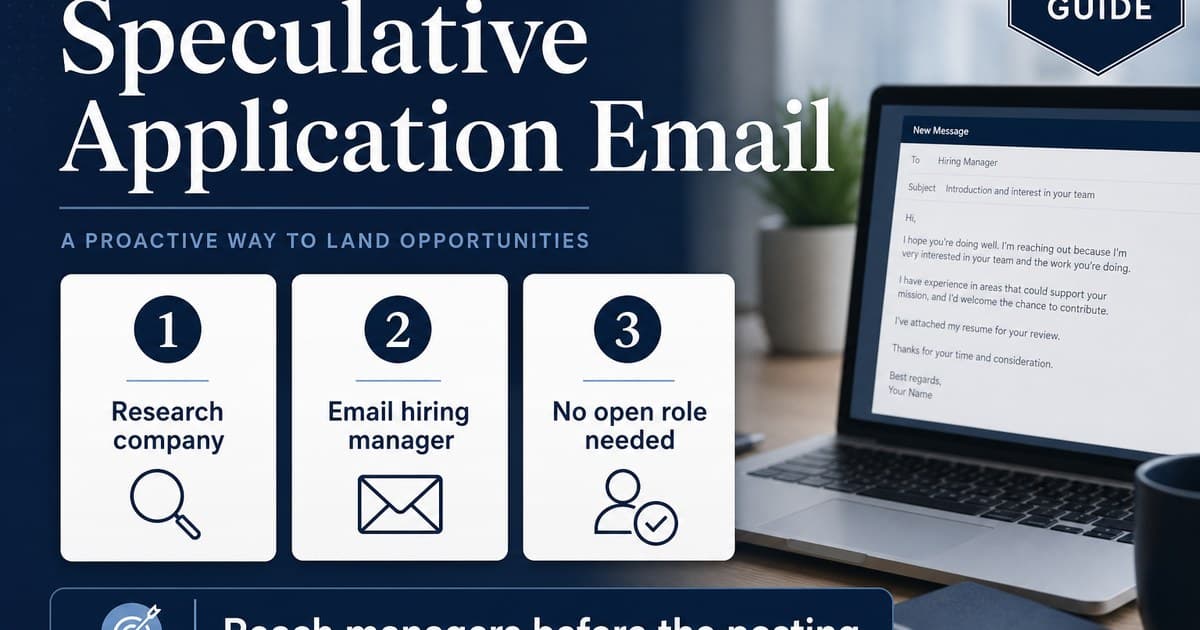
A speculative job application email reaches a hiring manager when no role is posted: one researched hook, one proof point, and a short ask for a conversation. It works because much of hiring happens before a requisition goes live. Portal apply cannot open that door; a plain-text note to the right decision-maker can.
Job boards only show the public slice of openings. The rest sits in the hidden job market: confidential replacements, budget that exists but is not advertised, and managers who hire from people already on their radar. A speculative application email is how you join that radar without waiting for a posting. This guide covers what to write, who to send it to, how European norms differ from US volume blasts, and how to run the channel without sounding desperate.
What is a speculative job application email?
A speculative job application email is a cold outreach note to a named hiring manager at a company that has not listed a matching role. You do not pretend a requisition exists. You say you know there may be no opening, explain why their work fits your background, and ask for a short call or permission to stay in touch. It is not a cover letter pasted into an ATS, and it is not a mass "open to opportunities" blast.
- Speculative: No public job ID; you initiate the conversation.
- Application-shaped: You still make a hiring case (fit + proof), not a networking coffee request with no substance.
- Email-first: Sent to a verified manager address, ideally plain text from your own inbox.
When should you send a speculative application email?
Send one when three conditions hold: you care about that company enough to research it, you can name a function or problem you would help with, and you have a verified contact for the manager who would own that work. Skip speculative email when your only reason is "they hire people like me" with no company-specific detail.
Strong timing signals include recent funding or product launches, a manager posting about team growth without a live JD, competitors hiring for similar roles, and relocation or visa windows where you need conversations before postings appear. For Europe-specific norms on tone and length, see European job search email etiquette and how to apply for jobs in Europe.
What should you write in a speculative application email?
Structure the first touch in four beats and keep it between 50 and 125 words: a company-specific hook, one proof point from your background, an explicit speculative frame (no open role assumed), and a single low-friction ask. Subject lines work best as role or function plus a concrete hook, not "Opportunity" or "Quick question."
- Hook: One fact you verified (product, stack, blog post, hiring note). Not their mission statement.
- Proof: One outcome with scope or a number, tied to that hook.
- Speculative frame: "I know you may not have an open role right now" removes the awkwardness of pitching into a void.
- Ask: A 15-minute call, or permission to share a short background note later. One ask only.
Do not attach a CV on touch one, paste your full resume inline, or claim you are a perfect fit for "any role." Specificity beats flexibility. For a longer framework that also covers posted roles, see the cold email template for recruiters and hiring managers.
Who should you email when there is no open role?
Email the hiring manager or team lead who would own the seat, not careers@, jobs@, or a recruiter who only processes portal volume. Function beats title guessing: find who leads engineering, product, or design for the work you care about. Wrong people get polite silence; generic inboxes get filtered.
Contact discovery is where most speculative campaigns stall. Pattern guessing and unverified addresses hurt Gmail reputation. PitchHired flows use Hunter and Apollo enrichment plus a targeting agent to surface function-relevant decision-makers so you spend time on the note, not twenty tabs per company. The full contact playbook is in finding the right stakeholder email.
Do speculative emails get better reply rates than portal apply?
Targeted cold outreach to hiring managers usually produces far more conversations per attempt than generic online applying. interviewing.io reports that cold outreach done well can yield one to two orders of magnitude more responses than applying online alone, with template bands around 25% to 50% when you find genuine common ground, and 5% to 25% for accomplishment-led notes used as a last resort.
Plan conservatively. For most job seekers, a realistic total reply band on well-targeted manager email is roughly 5% to 15%, with one follow-up after five to seven business days. Portal and auto-apply batches often sit near 0% to 1% meaningful response per 100 to 300 applications. Upper personalization bands are what strong research can approach, not a guarantee. More planning math lives in cold email reply rates for job seekers.
| Dimension | Wait for a posting | Speculative email |
|---|---|---|
| Timing | You enter after the JD and ATS queue exist | You can reach managers in the pre-posting window |
| Competition | Hundreds of applicants ranked by ATS rules | Near-zero direct competition before a listing |
| Ask | "Consider my application" | "Worth a short conversation if fit appears?" |
| Evidence needed | Keyword match to the JD | Company-specific research plus one proof point |
| Failure mode | Silent rejection in the portal | Generic note with no speculative frame or wrong contact |
How do you scale speculative outreach without sounding like spam?
Volume without research is how speculative email earns a bad reputation. Cap weekly sends to what you can research and reply to: for many seekers, 20 to 30 verified contacts per week is enough. Send plain text from your own Gmail, keep business-hours pacing, and stop after one follow-up. Identical templates with a swapped company name are easy to spot and easy to delete.
PitchHired runs that loop as a flow: candidate brief from your CV and portfolio, company research from crawled site markdown, dual-AI writer and reviewer drafts, hiring-manager targeting via Hunter and Apollo, then scheduled plain-text sends from your Gmail via OAuth with randomized delays, daily caps, and an outreach ledger from draft to sent. Access is pay-as-you-go credit packs with transparent monthly pricing. For AI draft quality without template voice, see what works in an AI message to a hiring manager.
Frequently asked questions about speculative application emails
What is a speculative application email?
A speculative application email is a short, researched note to a hiring manager at a company that has not posted a role you want. You acknowledge there may be no opening, show why you fit their work, and ask for a brief conversation instead of submitting through a careers portal.
Should I send a speculative email if there is no job posting?
Yes, when you have a concrete reason to contact that company: a product, stack, or team you researched, and a real skill match. Without that specificity, a speculative note reads like spam. With it, you reach managers during the pre-posting window when many seats fill through referrals and proactive candidates.
Who should I email for a speculative application?
Email the hiring manager or team lead who would own the role, not careers@ or a generic recruiter inbox. Name the function (engineering, product, design) and find the person who manages that team. Wrong contacts waste good copy and can hurt deliverability.
How long should a speculative job application email be?
Keep the first touch between 50 and 125 words. That is enough for one company-specific hook, one proof point from your background, a clear speculative frame (no open role assumed), and a single low-friction ask. Longer notes get skimmed or deleted on mobile.
Should I attach my CV to a speculative application email?
No. Offer to share a CV or portfolio if they want it. Unsolicited attachments often trigger security filters and make the note feel like a portal application instead of a conversation starter. One follow-up after five to seven business days is enough if they do not reply.
Ready to land interviews faster?
Stop uploading resumes to automated portals. Start pitching directly to hiring decision-makers today.
Get started