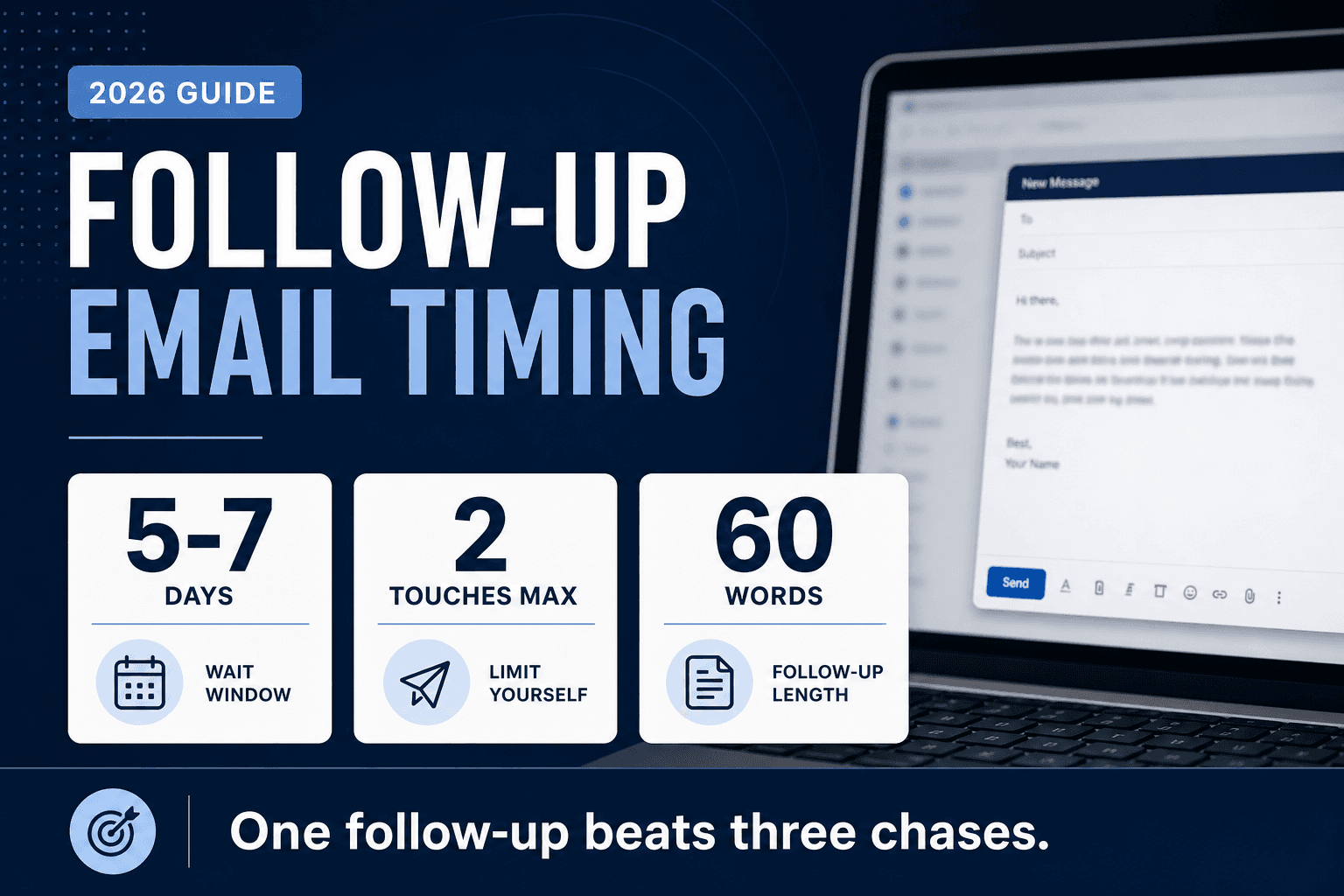
Send one follow-up email 5 to 7 business days after your first touch; stop at two total messages unless the recipient engages. That window captures busy hiring managers who saw but did not answer, without crossing into pushy territory. Three or more chases on the same thread usually hurt reply odds more than a single well-timed bump helps.
You applied, sent a cold note, or did both. Silence for a week feels personal; most of the time it is inbox volume. The question is not whether to follow up. It is when, how many times, and what to write so persistence reads as professional instead of desperate. This guide covers portal applications, direct hiring-manager outreach, European vs US cadence differences, and the copy structure that earns a second look. For the full first-touch template, see our cold email recruiter template. For why direct outreach beats portal queues, see how to bypass ATS with recruiter outreach.
When should you send a follow-up email after a job application?
Wait 5 to 7 business days after a cold email and 7 to 10 business days after a portal-only application before your one follow-up. Hiring managers batch-read recruiting mail on Tuesdays and Thursdays; sending on Monday morning or Friday afternoon often means your note sits buried until the next week. Business-day math excludes weekends and most public holidays in the recipient's country.
Skip follow-ups during obvious dead zones: late December, August in much of Europe, and the first 48 hours after a major company announcement when comms teams are flooded. If you received an automated "we received your application" reply, that is not engagement. Wait the full window before your bump.
Saleshandy's analysis of millions of cold emails (January to June 2026, cited in outreach benchmark roundups) reports that roughly 44% of positive replies arrive on follow-up touches, not the first send. The lift only works when the first note was specific and the follow-up is brief. A generic blast plus a generic chase still converts near zero.
How many follow-up emails are too many after a job application?
Two touches total: initial plus one follow-up. A third message to the same person without a reply moves you from persistent to pushy. Recruiters describe the pattern clearly: one follow-up shows interest; three unread notes signal that you will be difficult to manage in-role.
Exceptions exist but are narrow. If the hiring manager asks you to check back in a month, wait until that date and send one short note. If they redirect you to HR or a colleague, follow the new contact path instead of replying three more times on the original thread. If they say "not now," thank them and stop unless they invite you to reconnect later.
LinkedIn connection requests, InMail, and email on the same week count as multiple touches even if the channels differ. Pick one channel for the follow-up; do not pile on across platforms because email went quiet.
| Situation | Wait before follow-up | Max touches |
|---|---|---|
| Cold email to hiring manager | 5 to 7 business days | 2 (initial + one follow-up) |
| Portal apply, then manager email | 7 to 10 business days after portal submit | 2 on the email thread |
| Recruiter screen scheduled | No follow-up unless they cancel or ghost | 0 until 5 days after missed meeting |
| Post-interview thank-you | 24 hours after interview | 1 thank-you; 1 status check after 7 to 10 days if promised timeline passed |
| Speculative application (no open role) | 7 to 10 business days | 2; then pause 90 days before any new note |
What should you write in a follow-up email after no reply?
Under 60 words, same thread, one new detail. Reply in the existing email chain so the manager sees context immediately. Open by referencing the role and your first note's date. Restate interest in one sentence. Close with a polite exit that makes "no" easy.
Strong follow-ups add something the first note lacked: a link to a relevant project, a one-line reaction to a team blog post published since your first send, or a concrete availability window. Weak follow-ups repeat the entire pitch, re-attach a CV, or open with guilt ("just circling back", "bumping this to the top of your inbox").
Example structure (adapt, do not copy verbatim):
- Subject: leave unchanged (Re: [original subject])
- Line 1: "Following up on my note from [date] about the [role] on your [team]."
- Line 2: one new proof point or company-specific observation
- Line 3: "Still interested if timing works; happy to step back if not."
For AI-drafted first touches that need a human pass before send, see what works in an AI message to a hiring manager. The same anti-template rules apply to follow-ups: if it could go to any company, rewrite it.
How does follow-up timing differ after portal apply vs cold outreach?
Portal-only applicants compete in ATS queues where most CVs never reach a human. One follow-up to a verified hiring manager 7 to 10 business days after applying can surface your profile when the form submission did not. Mention you applied through the official channel; do not pretend the portal path never happened.
Cold outreach first puts you in a smaller inbox pool. interviewing.io reports one to two orders of magnitude more responses from targeted manager email than from online applying alone. Your follow-up window is shorter (5 to 7 days) because the manager already saw a direct ask from you, not an ATS auto-confirmation.
Combining both is valid: apply officially, then email the manager with one proof point the form could not carry. One follow-up on that email thread is enough. Do not also chase the generic recruiting inbox separately unless they asked you to.
Reply-rate planning math lives in our cold email reply rates data guide: at 10% replies, budget roughly ten researched emails per conversation you want; one timed follow-up often captures the marginal reply that makes the batch worthwhile.
What follow-up rules apply in European job markets?
One follow-up, shorter copy, longer wait than US advice suggests. German and Dutch hiring cultures treat direct email as normal but dislike aggressive cadence and superlative self-promotion. A second chase without engagement reads as pushy faster than in US-centric job-search forums.
Country-specific windows: Germany often uses 7 to 14 days for one follow-up; the Netherlands commonly uses 5 to 7 business days. Both cap at two total touches. August and late December are poor expectation windows across much of the EU.
GDPR does not ban professional B2B outreach to work emails when the message is relevant to the recipient's role. It does require honest identification, a proportionate ask, and an easy opt-out. Flooding the same person after they ignored you twice is both bad etiquette and bad compliance hygiene.
How can you pace follow-ups without burning Gmail reputation?
Batch-sending ten follow-ups in one hour from a new Gmail account triggers the same velocity alarms as batch-sending cold opens. Space sends across business hours with randomized gaps. Personal Gmail accounts have lower daily ceilings than paid Google Workspace; warming a new inbox means starting with small batches and increasing volume over weeks.
PitchHired schedules initial outreach in configured business-hour windows with paced delays between sends, daily caps tied to inbox warming tier, and an outreach event ledger that tracks draft, scheduled, and sent status. Dual-AI writer and reviewer agents produce the first touch; you control timing before anything leaves your authenticated Gmail via OAuth. That pacing matters because a follow-up only works if the first note actually landed in the inbox.
FAQ: follow-up email after job application
When should you follow up after applying for a job?
If you applied through a portal and have no direct contact, wait 7 to 10 business days before one brief follow-up to the recruiter or hiring manager if you can find a verified work email. If you sent a cold email first, follow up 5 to 7 business days later in the same thread. Do not chase every two to three days; that cadence reads as pressure, not persistence.
How many follow-up emails should you send after a job application?
Two touches total is the professional ceiling: one initial note plus one follow-up. A third message to the same person without a reply usually hurts more than it helps, especially in European hiring cultures where restrained outreach is the norm. If someone redirects you to HR or another colleague, that counts as engagement and you follow their path instead of stacking more notes on the original thread.
What should a job application follow-up email say?
Keep it under 60 words. Reference the role and date of your first note, restate interest in one sentence, and offer a clean exit ('happy to step back if timing is off'). Add one new detail if you have one: a relevant project update, a link to work that maps to their stack, or a note that you saw a team post. Do not rewrite your entire pitch or attach your CV again on the follow-up.
Is it okay to follow up if you already applied online?
Yes, when you can reach a verified decision-maker or recruiter with a role-specific note. Portal queues bury most CVs; a short email to the hiring manager after applying can surface your profile when the ATS filter would not. Mention that you applied through the official channel, then add one proof point the form could not carry. One follow-up a week later is enough.
Does follow-up timing differ in Europe vs the US?
European norms favor one polite follow-up after 5 to 10 business days and direct language without superlative self-promotion. US job-search advice often suggests faster cadences; that does not translate well to German, Dutch, or Nordic inboxes. When in doubt, wait longer and write shorter. See our Germany and Netherlands outreach guides for country-specific windows.
Next step: one follow-up, paced sends
Map your active applications to two-touch sequences: first note plus one timed follow-up, then stop. Upload your CV, connect Gmail via OAuth, and launch a researched batch with dual-AI drafts scheduled across business hours. Pay-as-you-go credit packs; credits never expire when you buy more.
Ready to land interviews faster?
Stop uploading resumes to automated portals. Start pitching directly to hiring decision-makers today.
Get started