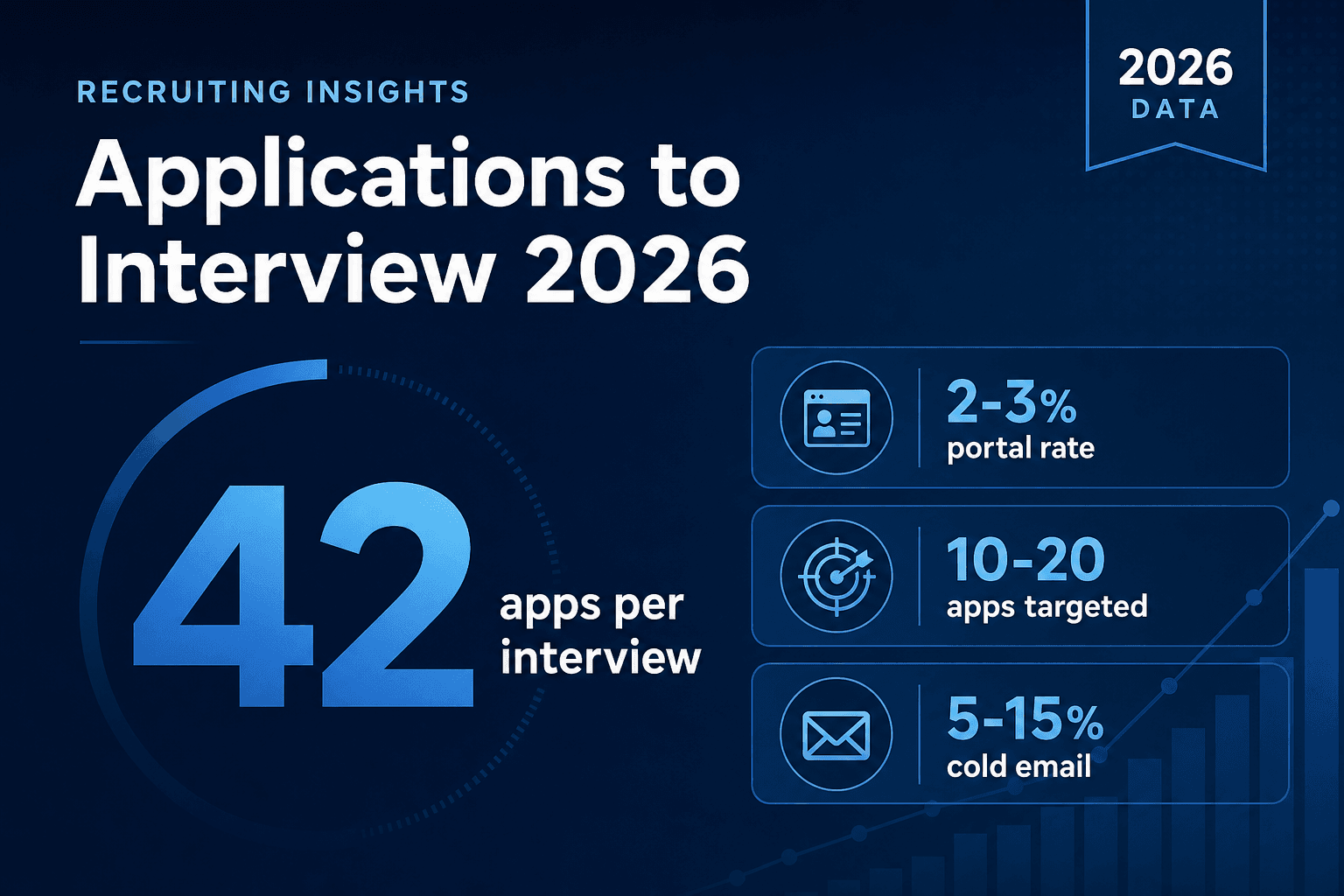
In 2026, generic portal applying takes roughly 40 to 42 applications to land one interview, at a 2% to 3% conversion rate. That is the market average, not a personal failure. Targeted applications, hidden-market outreach, and hiring-manager email can shrink the number dramatically. The lever is not always more clicks. It is better funnel math on the channel you control.
Job seekers ask this question when application number 30, 50, or 100 produces silence. The honest answer depends on channel, targeting, and how customized each submission is. This article collects named benchmarks for portal applying, shows how strategy shifts the ratio, and explains when direct outreach belongs in the same plan. Every number ties to a published source. Nothing here is PitchHired customer data or a invented case study.
How many job applications does it take to get an interview in 2026?
Plan on about 40 to 42 portal applications per interview at current market conversion rates. The Interview Guys aggregated 27 surveys and studies in 2025 and reported roughly 42 applications per interview, with only 2.4% of candidates reaching the interview stage. Their 2026 analysis puts the applicant-to-interview ratio near 2% to 3%: for every 100 people who apply to a corporate role, only two or three get invited to interview.
That ratio fell from higher bands in prior years. The Interview Guys cite an 8.4% interview rate in 2023, down from 15.25% in 2016. More applicants per posting, ATS filters, and auto-apply volume all compress the funnel. Zero interviews after 40 generic applications is statistically normal. It is also a signal to change channel or targeting, not to blindly send 200 more identical forms.
What does the 2026 hiring funnel look like by the numbers?
Portal applying, interviewing, and offers each have their own conversion step, and most seekers need triple-digit applications before an offer when they stay on portals alone. CareerPlug's 2025 Recruiting Metrics Report, cited by the Interview Guys, analyzed over 10 million applications and reported a 3% applicant-to-interview ratio in 2024. Average corporate postings attract 200 to 250+ applicants per role. Interview-to-offer conversion often lands near 25% to 30% in survey sets, meaning several interviews per offer is typical.
| Stage | Typical range | Source | Planning note |
|---|---|---|---|
| Applications per interview (portal) | Roughly 40 to 42 | Interview Guys (2025 aggregate) | Generic, untailored applying |
| Application-to-interview rate | Roughly 2% to 3% | Interview Guys; CareerPlug 2025 report | Per-role average, not your personal ceiling |
| Applications before offer (median) | Roughly 100 to 200 | Multiple 2026 hiring-funnel analyses | Wide variance by industry and seniority |
| Targeted applications (sweet spot) | 21 to 80 apps; ~31% offer probability cited | Interview Guys research roundup | Quality and fit over spray-and-pray |
| Fastest successful path (survey) | 10 to 20 applications before offer (20.8% of seekers) | Interview Guys State of Job Search 2025 | Tight targeting and strong materials |
The distribution matters more than the average. In the Interview Guys' 2025 survey, 20.8% of successful job seekers landed offers after just 10 to 20 applications, while 14.3% needed more than 100. Same outcome, very different volume. The gap is strategy, not effort.
Why does targeting change how many applications you need?
Customized, role-matched applications convert at roughly 10% to 20%, versus 2% to 3% for generic portal blasts. The Interview Guys describe 10% to 20% as an average application-to-interview ratio for strategic applicants, with 20% to 30% as a strong band. That translates to roughly one interview per 10 to 20 targeted applications, not 40 plus.
Mass auto-apply pushes the opposite direction. Community-tested batches of 100 to 300 portal applications often report roughly 0% to 1% meaningful response. You can hit the statistical average of 42 applications per interview while still feeling stuck if every submission is untailored, aimed at the wrong seniority band, or sent into postings with 500 plus competitors.
Practical targeting rules:
- Apply only when you meet most must-have requirements, not when a keyword vaguely matches.
- Tailor the first third of your CV and opening line to the posting's language, not a generic template.
- Prioritize companies and roles from the hidden job market where competition is lower and a human may actually read your profile.
- Pair portal applies with direct outreach when a posting exists. See how to bypass the ATS with hiring-manager email for the combined workflow.
Does cold email to hiring managers require fewer attempts than portal applying?
Direct email to verified hiring managers often produces more conversations per attempt than portal queues, because you compete against dozens of messages, not hundreds of ATS-ranked profiles. interviewing.io reports one to two orders of magnitude more responses from cold outreach to hiring managers than from online applying alone. For planning math on reply bands, see our cold email reply rate data for job seekers: roughly 5% to 15% total replies on targeted batches, with higher bands when copy is deeply personalized.
Work backward from reply rate. At 10% replies, ten researched emails might yield one conversation. At 5%, plan on twenty. Not every reply becomes an interview, but you are measuring a channel you control: contact quality, copy, follow-up timing, and deliverability from your own Gmail.
PitchHired is built for that lane, not portal volume: hiring-manager contact discovery via Hunter and Apollo enrichment, company research from scraped site markdown, dual-AI writer and reviewer loops for role-specific copy, and plain-text sends from your Gmail via OAuth with business-hours scheduling, randomized delays, and daily caps tied to inbox warming. Pay-as-you-go credit packs let you run targeted batches without a monthly subscription.
How should you track your own application-to-interview ratio?
Log applications, interviews, and channel separately so you know whether to fix materials, targeting, or outreach before sending more volume. The Interview Guys recommend tracking weekly. If you apply to 30 or more positions without an interview, volume is not the problem. Reassess targeting, CV positioning, or channel mix first.
A simple spreadsheet works:
- Portal applications sent (with company, role, date, tailored yes/no)
- Cold emails sent (recipient title, follow-up date)
- Replies and interviews (tag which channel produced each)
- Ratio per channel (applications or emails per interview, calculated monthly)
Healthy portal ratios for targeted seekers often land at one interview per 10 to 20 applications. If yours sits at 2% after genuine customization, the bottleneck may be role fit or market segment, not your work ethic. Shift effort toward smaller employers, hidden-market companies, or hiring-manager email where competition is thinner.
Frequently asked questions about applications per interview
How many job applications does it take to get an interview in 2026?
For generic portal applications, plan on roughly 40 to 42 applications per interview, reflecting a 2% to 3% application-to-interview ratio. The Interview Guys aggregated multiple surveys in 2025 and reported about 42 applications per interview. Targeted seekers who customize materials and pick tighter role fits often need far fewer attempts.
Is 50 applications with no interview normal?
At a 2% to 3% portal conversion rate, 50 applications might yield one or two interviews on average, but variance is wide. If you have zero interviews after 30 or more targeted applications, the problem is usually fit, materials, or channel choice, not bad luck. The Interview Guys recommend reassessing strategy before sending more volume.
How many applications does it take to get a job offer?
Most job seekers submit 100 to 200 applications before landing an offer when they rely mainly on portals, though successful candidates in survey data often land offers with 10 to 80 targeted applications. Interview-to-offer conversion often sits near 25% to 30%, so multiple interviews per offer is normal.
Does cold email reduce how many applications you need?
Cold email to verified hiring managers competes in a smaller inbox pool than ATS queues. interviewing.io reports one to two orders of magnitude more responses from cold outreach than from online applying alone. Plan in tens of researched emails per week, not hundreds of portal clicks, and measure reply rate per batch.
What application-to-interview ratio should I aim for?
For portal applying, 2% to 3% is the 2026 market average. Strategic applicants who tailor each submission often target 10% to 20%, or roughly one interview per 10 to 20 applications. Track your own ratio weekly. If you fall below 5% after 20 targeted applications, fix targeting or copy before scaling volume.
Ready to land interviews faster?
Stop uploading resumes to automated portals. Start pitching directly to hiring decision-makers today.
Get started